Alumina Fused Cast Corundum Blocks for Glass Furnaces: Alkali Corrosion Resistance with 50/50 α–β Interlocking Crystals
2026-03-16
Product description
In glass melting zones, alkali attack and molten-glass erosion are primary drivers of refractory wear, product contamination, and unplanned shutdowns. This article presents the technical value of Rongsheng Refractory’s high-purity alumina fused cast corundum blocks, engineered with an approximately 50% α-Al2O3 and 50% β-Al2O3 interlocking crystalline microstructure. The α/β interlock improves chemical stability under strong alkali conditions, limits penetration pathways, and helps maintain structural integrity during long high-temperature campaigns. A low-impurity formulation further reduces the risk of defect formation associated with foreign inclusions—supporting cleaner glass and more stable downstream quality. From a thermomechanical perspective, the material’s thermal stability and key property balance (e.g., thermal expansion behavior and thermal conductivity) contribute to more reliable lining performance across temperature gradients and operational fluctuations. Referencing common industry evaluation practices and standards frameworks (e.g., ASTM/ISO methods used for corrosion and material characterization), the article provides an engineering-oriented selection rationale and highlights field-validated results where lining service life can be significantly extended—often reported at 30%+ under comparable operating conditions—while lowering contamination risk in critical furnace areas.
Alkali Corrosion in Glass Melting: Why Fused-Cast Alumina Corundum Blocks Are Chosen for Cleaner Glass and Longer Campaign Life
In modern glass furnaces, refractory wear is rarely “just” a maintenance issue. Alkali-rich vapors, aggressive batch carryover, and turbulent melt convection can turn liner degradation into a quality risk—stone formation, cords, and inclusions often trace back to refractory/slag interactions. For engineers and technical decision-makers, material selection is therefore a controllable lever for extending furnace lining life and reducing contamination risk without destabilizing thermal balance.
Material focus
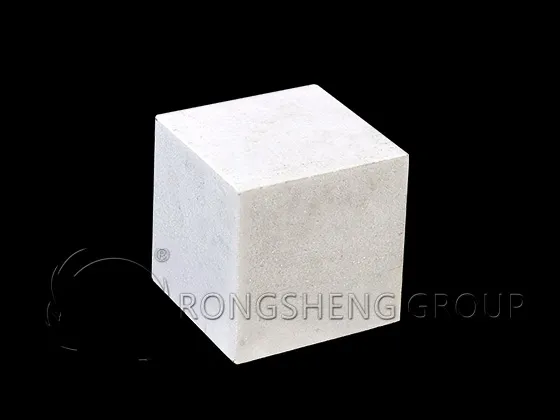
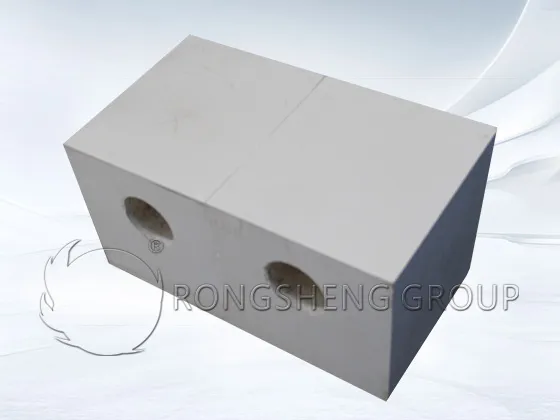
High-purity fused-cast alumina corundum blocks with an interlocked ~50% α-Al2O3 + ~50% β-Al2O3 crystal structure.
Use case
Glass melting zones where alkali corrosion and molten-glass erosion drive campaign cost and defect rate.
Brand
Rongsheng Refractory (高新技术企业; capacity approx. 130,000 tons/year; supplied to 70+ countries).
What “Alkali Corrosion” Really Means in a Glass Furnace Lining
In soda-lime and other alkali-bearing glass systems, refractory corrosion typically accelerates through a combination of alkali vapor attack, slag/batch reactions, and melt infiltration. The outcome is not only thickness loss—microstructural changes can promote spalling, increase surface roughness, and introduce foreign phases into the melt.
From an operational standpoint, engineers often see the consequences as tighter process windows: higher sensitivity to temperature fluctuation, increased risk of “stones” after thermal upset, and more frequent hot repairs. A refractory option that remains chemically stable in alkali-rich atmospheres, while resisting molten-glass erosion, directly supports longer campaign life and cleaner glass.
Microstructure Matters: The α/β Interlocking Mechanism and Alkali Resistance
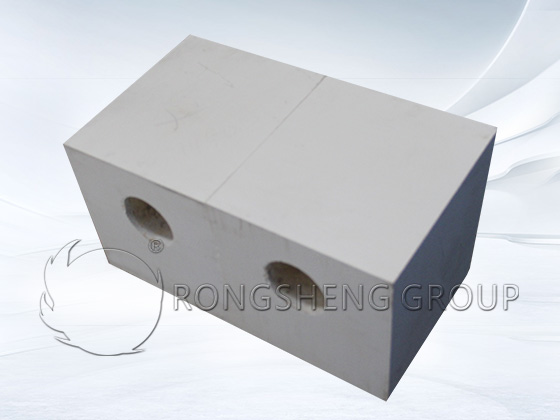
High-purity fused-cast alumina corundum blocks are valued because their performance is built into the crystal scale. Rongsheng Refractory’s fused-cast alumina corundum blocks adopt an approximately 50% α-Al2O3 and 50% β-Al2O3 interlocked structure. In practice, this interlocking crystal network helps:
Why the α/β network improves durability in aggressive melts
- Slower penetration pathways: a denser, intergrown crystal architecture can reduce connected porosity and limit alkali-bearing melt infiltration.
- Higher structural stability at temperature: the fused-cast body maintains integrity under sustained high heat, supporting stable furnace geometry.
- Lower spalling tendency under operational swings: improved cohesion at the microstructural level helps resist crack propagation when thermal gradients occur.
For technical buyers, this translates to an engineering benefit that is easy to justify: the refractory is less likely to become the limiting factor when alkali volatility increases or when pull-rate changes shift convective wear patterns.
Low-Impurity Design: A Practical Path to Fewer Defects and Less Color Drift
In glass melting, “refractory purity” is not a marketing phrase—it is a process safeguard. Lower impurity content reduces the probability that corrosion products become inclusions or seeds for bubble formation. When the refractory is chemically stable, the melt remains closer to its intended composition, helping maintain optical properties and downstream yield.
Quality risks linked to refractory impurities
- Inclusions (“stones”) from reaction products
- Bubble/seed stabilization on foreign particles
- Color drift in sensitive formulations
Operational value of high purity
- Cleaner melt environment, lower contamination risk
- More stable refining and fining behavior
- Better consistency across long campaigns
Thermo-Mechanical Stability: Parameters Engineers Watch (and Why They Matter)
Beyond chemical attack, glass furnaces punish materials with thermal gradients and long-duration exposure. Selection should consider thermo-mechanical behavior that impacts heat balance and structural integrity. For fused-cast alumina corundum, typical engineering-relevant ranges (for reference) include:
| Property (Reference) |
Typical Range for Fused-Cast High-Alumina Corundum |
Process Relevance in Glass Melting |
| Bulk density |
~3.4–3.7 g/cm³ |
Higher density generally supports lower permeability and better corrosion resistance. |
| Apparent porosity |
~1–5% |
Lower connected porosity reduces melt infiltration and reaction interface growth. |
| Thermal conductivity (hot) |
~2.0–4.0 W/m·K (at high temperature, grade-dependent) |
Affects heat distribution, fining stability, and local hot-spot behavior. |
| Linear thermal expansion |
~7.5–8.5 ×10⁻⁶ /K (20–1000°C) |
Influences stress at joints and interfaces; key for spalling control. |
| Cold crushing strength |
~150–350 MPa (grade-dependent) |
Supports mechanical robustness during installation and long campaigns. |
These ranges vary by grade, casting route, and QA criteria; however, they provide a practical checklist for how refractory properties map to furnace stability. For decision-makers, the point is simple: stable thermo-mechanical behavior reduces unplanned variability—often the most expensive “hidden cost” in glass operations.
Standards & Test References (for engineering alignment)
For comparative evaluation and documentation, many plants align internal specifications with recognized test methods. One commonly referenced framework for refractory characterization includes ASTM methods for physical properties and corrosion testing practices, and ISO methods for bulk density/porosity and mechanical strength verification (depending on local procurement requirements).
Note: When a project document lists “ASTM C150,” engineering teams typically verify it carefully, as ASTM C150 is widely known in cement specifications; refractory testing more often refers to other ASTM/ISO property and corrosion methods. A precise, mutually agreed test plan is recommended before final approval.
Performance Evidence: What “Longer Life” Looks Like in Real Campaign Terms
In comparative evaluations across glass-melting applications, high-purity fused-cast alumina corundum blocks are frequently associated with measurable reductions in corrosion wear rate and fewer quality-related interruptions. Based on typical industry observations in aggressive alkali conditions, engineers often report:
Reference improvement (typical)
- Campaign life: +20% to +35% versus conventional high-alumina options in comparable zones
- Corrosion wear rate: ~15% to 30% reduction under alkali-bearing melt exposure
- Glass defects: lower inclusion-related incidents where impurity control is critical
What engineers usually monitor
- Thickness loss mapping at hot spots and doghouse-adjacent areas
- Defect trending (stones/cords) correlated to refractory interface events
- Thermal profile stability after pull-rate changes
For plants that operate at scale, even a 30% increase in lining life can reshape outage planning: fewer emergency interventions, better spare-part predictability, and less production variability during the campaign tail.
Application Guidance: Where Alkali-Resistant Corundum Blocks Deliver the Most Value
Fused-cast alumina corundum blocks are typically considered for high-corrosion zones where molten-glass flow, batch carryover, and alkali vapor exposure combine. In selection discussions, engineering teams often evaluate:
A practical decision checklist (engineering-facing)
- Glass chemistry & volatility: alkali level, fining agents, and expected vapor loading.
- Temperature regime: continuous operating temperature and transient swings (start-ups, pull-rate changes).
- Flow/erosion intensity: convection patterns, bubbling, and throat/sidewall shear effects.
- Quality targets: tolerance for inclusions, optical purity requirements, defect cost impact.
- Installation and joint design: dimensional control, interface materials, and expansion strategy.
Rongsheng Refractory supports global glass producers with consistent supply, documented QA, and export experience across diverse furnace designs—an important factor when material performance must remain consistent across sites and rebuild cycles.
Engineer-to-Engineer Support: Confirm Fit for Your Alkali-Rich Furnace Zone
Share your glass type, hot-face temperature, and target installation zone to receive a concise technical recommendation—focused on alkali corrosion resistance, glass cleanliness, and campaign life extension.
Request a Technical Datasheet for Fused-Cast Alumina Corundum Blocks
Typical input needed: furnace zone drawing (optional), glass composition family, operating temperature, and expected campaign target.
Keywords embedded for search relevance: fused cast corundum refractory brick, glass furnace refractory materials, high purity refractory, alkali corrosion resistant refractory brick, corundum block application, high temperature industrial refractory materials, glass melting refractory solution, Rongsheng Refractory.